


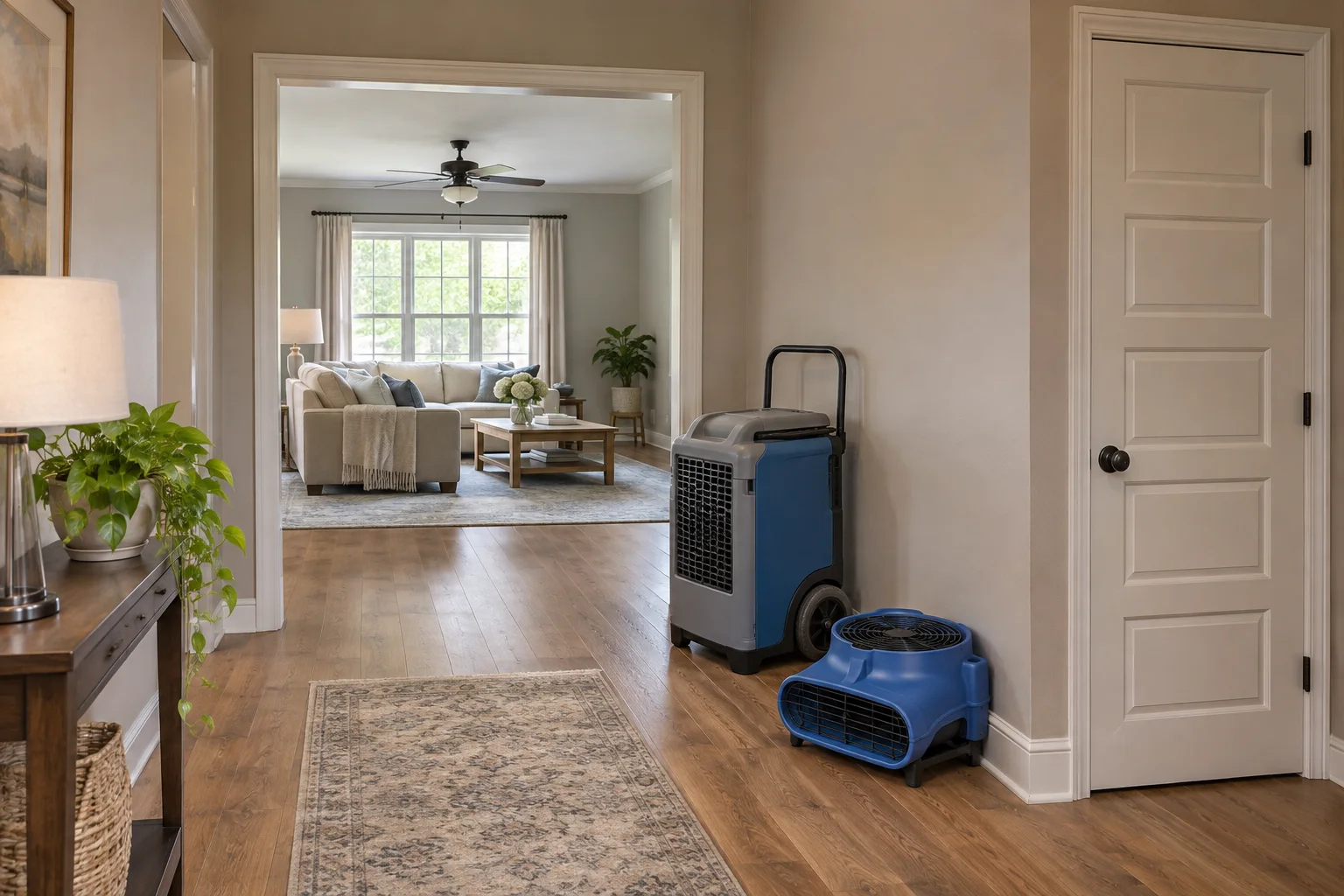
Can You Stay Home During Water Damage Restoration?

A water loss does not automatically mean you must leave, but an apparently dry bedroom does not automatically make an overnight stay safe either. Before deciding where to sleep tonight, ask the restoration contractor which areas and routes the work affects and who must check the utilities, structure, and air system. If those questions cannot yet be answered, arrange a place to stay while the responsible professionals assess the home.
A brief visit to collect belongings, using a separate room during the day, and sleeping in the house overnight are different decisions. Ask specifically about each use and each person in your household. Follow any restriction from local officials or the property owner, and do not enter a restricted area to investigate it yourself.
First, understand the kind of water loss
A small appliance-line leak and a major flood need different assessments. The EPA distinguishes limited pipe leaks or rainwater intrusion from major floods, which generally affect more area and present more hazards. See the EPA’s flood cleanup guidance. Tell the contractor what you know about the source and where water traveled; an early description is not a diagnosis of concealed damage.
When should you wait outside?
After flooding has damaged a home, the CDC says to wait until a building inspector has examined the building for safety before entering. Its reentry guidance also advises calling an electrician if reaching the main switch would require crossing standing water. Do not walk through water to operate electrical equipment. Ask local officials about a damaged structure and a qualified electrician about electrical hazards; the restoration contractor’s work-area plan does not replace those checks.
If power was shut off after flooding, the CDC advises having an electrician check the home’s electrical system before power is turned back on. Ask the electrician and utility who is responsible for the next step; see the CDC reentry checklist. If a gas or other utility is affected, ask the appropriate utility or qualified professional about its status before relying on it.
Ask about each room, route, and essential service
Walk through these questions with the restoration contractor from a safe location. Ask for the answer for tonight and for the next work phase, including who will notify you if it changes.
- Bedroom: Is the room outside the affected and restricted work areas? Ask the contractor whether moisture assessment or planned work could change its use. Ask again when the work boundary changes.
- Bathroom and water: Can everyone reach a usable bathroom without entering the work area, and is the water suitable for its intended use? After flooding, follow local water guidance. The CDC says not to use water suspected of contamination for food preparation or personal hygiene; see its safe-water advice. Check with the water utility or local health authority when safety is uncertain.
- Route: Is there an accessible path between the entrance, bedroom, and bathroom that stays outside the work area? Ask the contractor how equipment, cords, barriers, and demolition will affect that route, and revisit it before each phase.
- Shared heating and cooling: Does the system serve both the affected area and the rooms you hope to use? Ask a qualified HVAC professional whether the system was affected and whether it can operate. The CDC says a flood-affected HVAC system should remain off until an experienced professional checks and cleans it, because a contaminated system can spread mold; see the CDC’s HVAC guidance.
- Separation from work: What barriers or other controls are planned, and do they allow the proposed route and room use? In its guidance for schools and commercial buildings, the EPA describes containment as a way to limit mold and debris moving beyond a work area. That building-work principle is a question to discuss with the contractor, not an automatic clearance for a home.
Consider who will be there
Household needs can change the decision even when a separate room is available. The CDC advises people with asthma, COPD, or a compromised immune system to stay out of a moldy home, including during cleaning. Read the CDC mold cleanup guidance and discuss individual health concerns with a clinician. Do not assume an apparently dry room resolves those concerns.
For flood cleanup, the EPA says children and pregnant people should not participate in the work. See the EPA’s flood cleanup guidance. Participation in cleanup and living elsewhere are separate questions; ask the appropriate professionals about the actual conditions and your household’s needs.
How the answer can change
Imagine a limited appliance-line leak: a bedroom and bathroom appear untouched on the other side of the home. That appearance is a starting observation, not permission to stay. The contractor still needs to assess the affected area, the route, and planned work; an HVAC professional may need to evaluate shared air. If those checks leave uncertainty about overnight use or essential services, plan to stay elsewhere while they are resolved.
Now imagine floodwater has affected the main route or an essential utility. A separate bedroom alone does not provide a usable path or establish that power and water are safe. Wait for the relevant inspector, electrician, utility, and restoration team to address their respective parts before considering entry or a return.
Ask for a fresh answer if opening a wall reveals more moisture, a barrier moves, a route closes, or a utility or air system is found to be affected. The EPA’s professional building remediation guide notes that a work plan may need to change as conditions or information change. Before returning, ask which areas are available, which checks remain, and who can confirm each one. The EPA’s home mold guidance also calls for fixing plumbing leaks and other water problems and drying affected items completely; that cleanup step alone is not an occupancy clearance.
For the broader sequence, read what happens after you call for water damage restoration. For help assessing affected areas, moisture, and the drying scope in the Louisville or Shepherdsville area, contact Mold Hunters’ water damage restoration team.
Practical Restoration Guidance
A professional response follows a clear process
A professional restoration response is a documented process for finding the source of property damage, controlling immediate hazards, measuring affected materials, removing contamination when necessary, and drying or rebuilding the property.
For property restoration in Kentucky and Southern Indiana, the right sequence depends on the source, the materials involved, and whether occupants can remain safely in the building. Mold Hunters starts with conditions at the property, not a one-size-fits-all treatment.
Find the source
Trace where the damage began and how far water, smoke, odor, or contamination traveled.
Control hazards
Stabilize immediate risks and set the right containment or safety controls before cleanup begins.
Measure and restore
Document affected materials, remove what cannot be saved, then clean and dry the structure.
Verify and rebuild
Confirm the area is ready, preserve the project record, and complete permanent repairs.
Safety first
What to do before the restoration crew arrives
Do not enter electrically energized water, disturb suspected sewage, or walk through a fire-damaged structure that has not been cleared. Follow instructions from local emergency officials.
- Stop and assess immediate danger Leave for fire, electrical, structural, sewage, or breathing hazards. Contact emergency services when needed.
- Limit the source only when it is safe Shut off a known water supply or HVAC system only if the control is safely accessible.
- Document conditions from a safe location Take wide and close photographs, record when the loss was found, and preserve receipts and communications.
- Call a qualified restoration provider Describe the source, affected rooms, visible materials, odors, and vulnerable occupants.
- Contact the insurer Ask about mitigation duties, deductibles, documentation, and approvals without delaying reasonable loss control.
Floodwater may contain biological or chemical hazards. Homeowners should not treat contaminated water, widespread mold, or unstable fire debris as a routine cleaning project.
A record you can follow
Why documentation and verification matter
Good restoration work produces a record. Depending on the job, that record can include initial photographs, moisture readings, affected-material notes, equipment logs, disposal records, progress photographs, and a final walkthrough. Documentation helps the owner understand what changed and gives an insurance adjuster a clearer basis for reviewing covered work.
Verification should match the loss. Water work may require moisture readings compared with dry materials. Mold work requires source correction and a visibly clean contained area. Fire restoration may require repeated inspection for soot and odor in connected spaces.
Plain-language definitions
Common restoration terms
- Mitigation
- Immediate work intended to stop continuing damage and stabilize the property before permanent repairs.
- Remediation
- Controlled correction of contamination through source control, containment, removal, cleaning, and verification.
- Structural drying
- Measured removal of excess moisture using extraction, airflow, dehumidification, and monitoring.
- Reconstruction
- Repair or replacement after the affected area has been cleaned, dried, and stabilized.


